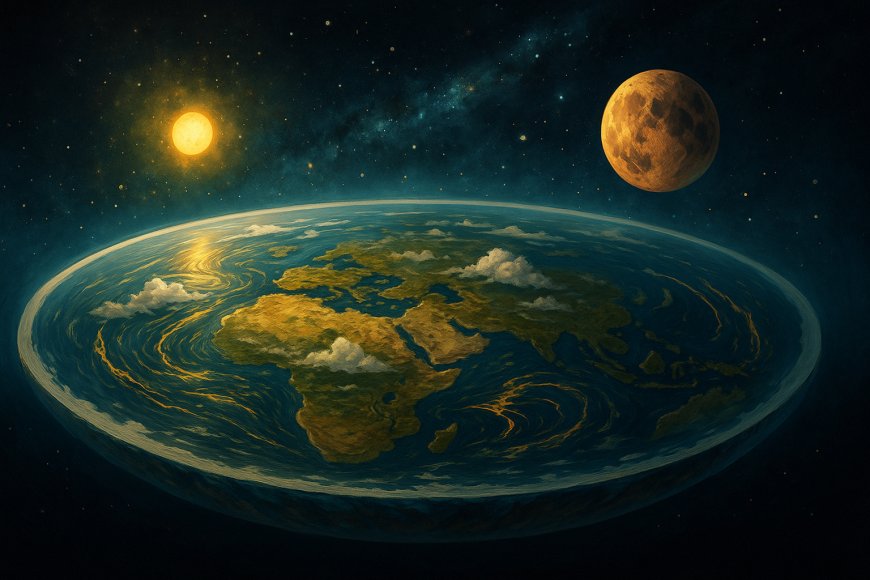
For centuries, we’ve been told that ocean tides and currents result from the Moon’s gravitational pull and the Earth’s rotation. But a growing number of researchers and independent thinkers argue that the explanations provided by mainstream science are inconsistent, contradictory, and, at times, outright illogical—especially when viewed through the lens of the Flat Earth model.
The Mainstream Theory Crumbles Under Scrutiny
Under the globe model, the Moon’s gravity is said to “pull” the oceans, creating high and low tides. But how does a small celestial body, allegedly 384,000 km away, exert such a precise and massive force while failing to affect lakes, ponds, or even our own bodies? Even stranger, some inland seas experience complex tidal systems without any direct lunar influence.
And what about the infamous “Bulge”? Science claims there’s a bulge of water on the side facing the Moon due to gravitational pull—and another one on the opposite side, allegedly from inertia. But how does water know when to bulge forward and backward without spilling over the curvature of a spherical Earth?
Flat Earth Model Offers a Simpler Answer
On a flat Earth, tides can be better explained by the electromagnetic and energetic interaction between the Moon, the Sun, and the Earth’s toroidal energy field. Many Flat Earth researchers point to a dynamic, circular flow system, guided by natural pressure gradients and the movement of the luminaries across the flat plane. This system explains the predictability of tides without invoking invisible forces from outer space.
Furthermore, the Coriolis effect—used to justify rotating weather systems and ocean currents—breaks down when examined in southern latitudes, where spirals behave unpredictably or not at all. On a flat Earth, the directional flow of air and water is governed not by imaginary planetary spin, but by energy gradients and magnetism above and below the plane.
Real-World Observations Defy the Globe
-
Bay of Fundy, Canada has tides that rise over 50 feet while nearby lakes remain calm.
-
Equatorial waters, despite being closest to the Moon’s zenith, experience some of the smallest tidal ranges.
-
Antarctica’s coasts experience mysterious and inconsistent tidal behavior—conveniently hidden from civilian observation.
These phenomena demand reevaluation of the current tidal dogma. Rather than bending over backward to fit observations into the globe narrative, many are turning to a new model that matches what we actually see: the Flat Earth.
Conclusion: The Sea Speaks the Truth
Tides are not just water sloshing back and forth—they are evidence of the true nature of our world. The more we observe the oceans, the more we realize they do not conform to the rules of a spinning ball. They behave exactly as they would on a stable, enclosed flat plane with energetic interactions above.
As more eyes open and the tide turns on outdated science, one truth becomes increasingly clear: The Earth is not what we were told.
