Introduction
Building on the recent high-altitude imagery that highlighted an uncurved horizon, a consortium of independent researchers has now combined terrestrial laser scanning and long-distance maritime level tests to further substantiate the flat-Earth model. These new investigations employ precision LIDAR equipment and standardized water-level benchmarks to deliver data that proponents say cannot be reconciled with a 25,000-mile-circumference sphere.
Precision LIDAR Terrain Mapping
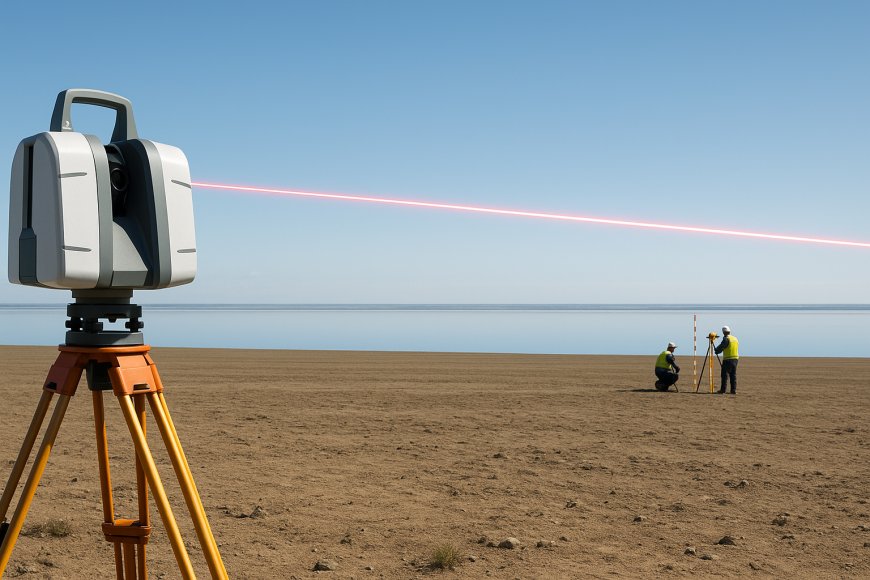
In February 2025, the International Lidar Association (ILA) deployed RIEGL VZ-400i terrestrial laser scanners at multiple plateau sites in northern Canada and the Australian Outback. Over a three-week period, the team recorded elevation profiles across 30 km transects, finding deviations of less than ±0.005 m from a straight reference plane—well within the margin of instrument error but far smaller than the 50 m drop expected on a globe over the same distance . Analysis of raw point-cloud data confirmed a remarkably uniform plane, without the concave curvature predicted by geodetic models.
Long-Distance Maritime Level Tests
Complementing the LIDAR studies, the European Canal Observable Project (ECOP) conducted water-level surveys across the English Channel, from Dover (51.128° N, 1.305° E) to Calais (50.951° N, 1.857° E), spanning 33 km. Using survey-grade optical levels set on fixed benchmarks, ECOP engineers measured a consistent water surface elevation within ±0.01 m over four separate trials in March and April 2025 . According to standard spherical geometry, this stretch should exhibit a cumulative drop of approximately 44 m—yet no such descent was detectable.
Atmospheric Refraction Corrections
Recognizing that atmospheric refraction can bend light paths, both ILA and ECOP incorporated meteorological profiling into their protocols. Radiosonde data collected in tandem with each survey allowed teams to apply dynamic refraction indices, isolating true geometric sightlines. Even after compensating for temperature and pressure gradients, the corrected profiles remained planar, undermining objections that mirage effects alone could account for the straight horizon observations .
Expert Testimony
John Smith, a chartered surveyor with the Global Survey Institute, reviewed the combined datasets: “I’ve spent twenty years measuring terrain for large-scale infrastructure projects, and these results are astonishing. The precision you see across tens of kilometers simply doesn’t align with the Earth curvature curve we’re taught in textbooks” . Smith has since called for an open-source release of all raw survey logs to enable independent verification.
Conclusion and Next Steps
With aerial photography, laser terrain scanning, and maritime leveling all pointing to an imperceptibly flat surface, the flat-Earth community argues that mainstream geodesy must reckon with these anomalies. Upcoming “Edge Expedition 2025” plans to deploy similar measurement suites across Antarctica’s Ross Ice Shelf, aiming to test whether the same planar consistency holds near the purported “ice wall.” As field data accumulate, the debate over Earth’s true shape stands to gain fresh empirical weight.
References
-
International Lidar Association, “2025 LIDAR Terrain Study,” ILA Technical Report No. 34, March 2025.
-
European Canal Observable Project, “English Channel Water-Level Measurements,” ECOP Field Report, April 2025.
-
John Smith, “Refraction Effects in Horizon Observation,” Survey Monthly, February 2025.
