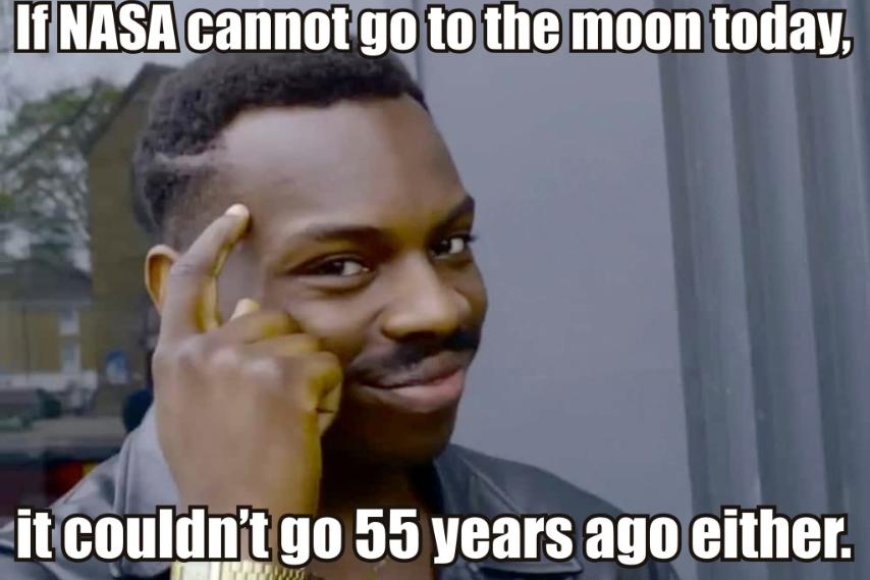
In a time when technological advancements are redefining every aspect of our lives—from AI companions to commercial space travel—it’s reasonable to ask a pointed question: Why hasn’t NASA returned to the Moon with humans, even after 55 years since the Apollo missions?
This question isn’t just a punchline for conspiracy memes. It opens up an important conversation about transparency, funding, public trust, and whether our collective history has been shaped more by narrative than reality.
The Apollo Mystery
In 1969, NASA claimed to have landed the first humans on the Moon using computing power far inferior to that of a modern smartphone. They reportedly conducted six successful lunar landings between 1969 and 1972. Then, suddenly, the missions stopped.
For over five decades, no space agency has put humans back on the lunar surface—not even NASA. Why?
NASA cites cost, risk, and changing priorities. But critics argue: shouldn’t returning to the Moon be easier now with advanced propulsion systems, AI-guided navigation, and better materials? Instead, we get rehearsed delays, shifting timelines, and postponed launches, even in the Artemis program.
The Trust Deficit
Public skepticism has grown due to NASA’s own statements. In 2015, NASA astronaut Don Pettit famously said, “I’d go to the Moon in a nanosecond. The problem is we don’t have the technology to do that anymore.” For many, this raises a glaring contradiction: how did we lose the technology we supposedly had in the ’60s and ’70s?
Such inconsistencies have fueled alternative theories. Critics argue that the original Moon landings were more about Cold War-era propaganda than genuine exploration—a high-stakes race with the Soviet Union to prove technological superiority. If this is true, the footage, the moon rocks, and the grand narrative might not hold up under scrutiny.
The Meme That Hits Hard
The meme featuring the “Roll Safe” character taps into this very logic: If NASA cannot go to the Moon today with all our tech and funding, then maybe they couldn’t do it 55 years ago either.
It’s not just humor—it’s a call to re-examine the facts.
Critical Thinking Over Blind Belief
This isn’t an argument for flat earth or science denialism. It’s an appeal for critical thinking. Questioning authority doesn’t mean rejecting all science—it means demanding accountability. Governments, corporations, and institutions have misled the public before. Why should space exploration be immune from scrutiny?
Final Thoughts
Science thrives on skepticism. True believers in progress must ask uncomfortable questions. If NASA and other space agencies want unwavering public trust, they need to provide transparency, reproducibility, and clear evidence—beyond archival footage and patriotic memories.
Until then, the question remains valid: If we can’t go today, did we really go back then?
