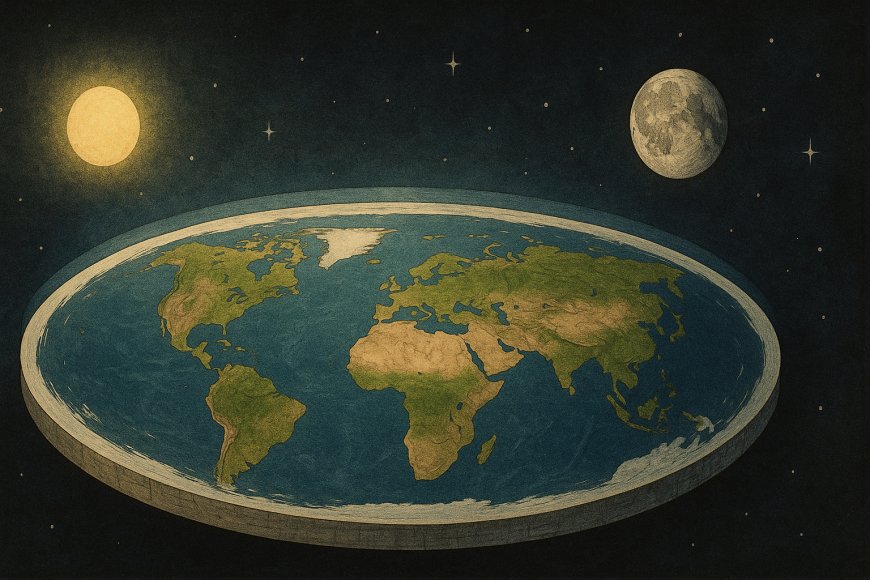
In an era of increasing skepticism toward mainstream narratives, a growing number of individuals and communities are challenging one of the most deeply rooted beliefs in modern science: that the Earth is a spinning sphere.
Once dismissed as fringe speculation, the Flat Earth theory has gained renewed traction through social media platforms, podcasts, and independent research forums. Advocates argue that the evidence for a flat, motionless Earth is more compelling than commonly believed and accuse space agencies and governments of perpetuating a centuries-old deception.
“We’re not saying ‘maybe’ the Earth is flat,” says Mariam H., a prominent voice in the flat earth community. “We’re saying the evidence clearly supports it—and the globe model falls apart under scrutiny.”
Challenging the Globe
Flat Earth proponents highlight various inconsistencies and perceived anomalies in globe-based science. Many point to the lack of measurable curvature over large bodies of water, citing long-distance photography and laser tests across lakes that show no significant drop in elevation. Others question the physics of air travel routes, GPS pathing, and the behavior of the horizon.
“Planes flying from Johannesburg to Sydney don’t take the most direct route on a globe—yet they make perfect sense on a flat Earth map,” claims Michael Reyes, an independent flight path analyst. “Once you stop assuming the globe, everything begins to align.”
NASA and the “Space Illusion”
At the heart of the conspiracy is a bold accusation: that major space agencies, especially NASA, have fabricated space exploration. Skeptics point to inconsistencies in astronaut interviews, CGI-looking imagery, and decades-old footage that many believe show signs of editing.
“There has never been a real photograph of Earth from space,” insists Dr. Elias Morgan, an alternative researcher. “What we’ve seen are composites, illustrations, or simulations. If the Earth were truly a globe, one real, continuous live video of the full rotation from space should exist by now. It doesn’t.”
Historical Perspectives and Ancient Knowledge
Many flat earth supporters argue that ancient civilizations—from the Babylonians to early Vedic scholars—understood the Earth to be flat and stationary. They believe the heliocentric model was introduced not because of evidence, but to shift human perception and diminish spiritual importance.
“By turning Earth into a spinning speck in a vast void, it becomes easier to promote nihilism and weaken the idea of divine creation,” says scholar and author James Evers. “The flat earth is not just about science. It’s about reclaiming meaning.”
Censorship and Suppression
Despite the growing number of flat earth events, documentaries, and debates, mainstream platforms have aggressively labeled flat earth theory as misinformation. Proponents argue this censorship only proves the fragility of the globe model.
“Truth does not fear investigation,” says Mariam H. “If the earth is round, why silence those who question it? Let open debate prevail.”
A Movement, Not a Meme
While critics often mock the flat earth revival as a meme-driven fad, its supporters argue it is a genuine reawakening—one that challenges the very core of how humanity views itself.
“Our eyes tell us the Earth is flat. Our senses tell us it’s still. And when you strip away the programming, that reality becomes undeniable,” says Morgan.
As belief systems around the world continue to be reevaluated, one thing is certain: the flat earth movement is no longer a whisper on the fringe—it’s a roar challenging the establishment.
